Sep 12, 2026Procurement Guides
How to Calculate Steel Pipe Weight per Metre (Formula and Example)
Use the standard formula W = 0.02466 x wall thickness x (outside diameter - wall thickness) to estimate welded steel pipe weight per metre before you order or quote freight.
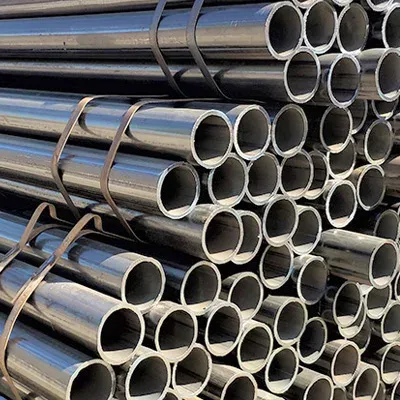
Quick answer: for welded steel pipe, the theoretical weight per metre is calculated as W (kg/m) = 0.02466 x wall thickness x (outside diameter - wall thickness), with dimensions in millimetres. The formula applies to general welded steel pipe and to the related families such as oxygen-blowing pipe, wire casing, galvanized steel pipe, transformer pipe and electric-welded special-shaped pipe. It gives a theoretical figure, so the actual weight can differ slightly with tolerances.
The Formula
W (kg/m) = 0.02466 x thickness x (outer diameter - wall thickness). Enter both the wall thickness and the outside diameter in millimetres, and the result is the theoretical weight in kilograms per metre of pipe.
A Worked Example
Take a pipe with an outside diameter of 219 mm and a wall thickness of 6 mm. The inside term is 219 - 6 = 213. Multiply 0.02466 x 6 x 213, which gives approximately 31.5 kg per metre. Multiply by the length of the pipe to get the weight of a single piece, and by the number of pieces to get the shipment weight.
Why the Calculation Matters
Weight drives three commercial decisions. It sets the freight estimate, because sea freight is charged on weight or volume, whichever is greater. It determines the lifting and handling plan at both ends of the shipment. And it anchors the commercial invoice, since steel pipe is often traded by weight rather than by piece. A quick theoretical check before quoting avoids unpleasant surprises later.
The formula gives a theoretical weight - always confirm against the mill's actual figures when the order is priced by weight.
Practical Notes
Keep the units consistent: the constant 0.02466 is set up for millimetres and kilograms per metre. Apply the formula per metre and multiply by length, rather than trying to apply it to a whole bundle at once. Remember that galvanized pipe weighs slightly more than the same black pipe because of the zinc layer, and that the theoretical result assumes nominal dimensions, so actual weight will vary within the permitted tolerance.
FAQ
What do I need to apply the formula?
Only the outside diameter and the wall thickness of the pipe, both in millimetres. No grade information is needed for the theoretical weight.
Does the formula work for all steel pipe?
It is the standard theoretical formula for welded steel pipe and the related pipe families. For special sections or heavily coated pipe, confirm the actual weight with the supplier.
Why is galvanized pipe slightly heavier?
The zinc coating adds mass on top of the steel wall, so galvanized pipe weighs marginally more than the equivalent black pipe.
Is theoretical weight the same as actual weight?
Not exactly. It is a calculated figure based on nominal dimensions; actual weight varies within the permitted dimensional tolerance.
Send your sizes, quantities and destination port to our engineering team and we will confirm theoretical and actual weights for your order.