Sep 12, 2026Procurement Guides
Steel Pipe Pile: A Reliable Foundation Piling Material
Steel pipe piles are seamless or welded carbon steel tubes used to support and stabilize foundations in ports, marine works and heavy structures.
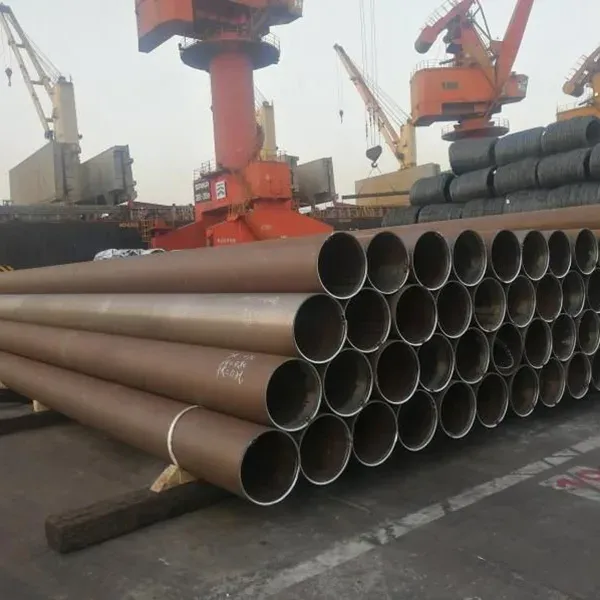
Quick answer: a steel pipe pile is a steel pile made from seamless or welded carbon steel pipe, typically SSAW or LSAW, driven into the ground to support and stabilize a foundation. Pipe piles are a commonly recommended piling material for seaport and stockyard buildings and are also used for marine structures, bridges, railways, highways and heavy building supports. Common sizes range from about 250 mm to 1500 mm outside diameter with wall thickness of about 8 mm to 25 mm, and coatings such as galvanized, FBE or 3PE are applied according to the soil and marine environment.
What a Steel Pipe Pile Is
A steel pipe pile is a structural construction material that usually refers to seamless or welded carbon steel pipe, including SSAW or LSAW pipe, used to support and stabilize building foundations. It transfers building loads through weak surface soil to stronger strata below, which is why it is one of the most recommended piling materials for seaport and stockyard buildings and ocean engineering.
Where Steel Pipe Piles Are Used
Typical applications include onshore and offshore construction, marine infrastructure and structures, railway and highway construction, and structural support for specific buildings. Where soil is loose and cannot provide the required support, a pipe pile distributes weight evenly and reaches deeper into the soil, which is valuable for very large buildings. When the land area is small, pipe piles allow the structure to be carried on a smaller footprint with better stability.
Common Sizes, Forms and Coatings
A widely used form of pipe pile is large diameter heavy steel pipe, commonly from about 16 inches to 60 inches, manufactured by seamless, longitudinal welding (LSAW) or spiral welding (SSAW). Depending on the soil environment, pipe piles can be galvanized or coated with FBE or 3PE. The outside diameter generally ranges from about 250 mm (10 inches) to 1500 mm (60 inches), with wall thickness typically from about 8 mm to 25 mm. Sizes and coatings should be selected with the geotechnical and structural design.
Open-End and Closed-End Pipe Piles
Pipe piles are divided into open piles and closed piles according to soil conditions. An open pipe pile has an open driving end and no driving point, and is usually used to pass through rock or hard areas; as the open end sinks, soil can be removed by jetting water or compressed air, and the pile is later cleaned and filled with concrete. A closed pile, or plugged pipe pile, has its driving end sealed by welding tapered steel or cast iron, such as a rock shoe, to the pipe end, and is also filled with concrete after driving.
Reference Standard for Pipe Piles
Most pipe pile standards refer to ASTM A252, divided into Grade 1, Grade 2 and Grade 3. This specification generally applies to cylindrical wall steel pipe, where the steel cylinder acts as the bearing member of concrete cast-in-place piles. Pipe piles are usually manufactured by seamless, resistance welding, fusion welding and flash welding, with longitudinal and spiral welds. The standard also specifies tensile requirements and minimum values, together with common dimensions and weights.
Installation and Design
Installing pipe piles requires a pile driver that drives the piles deep using a hydraulic system. When steel piles are driven directly into the soil instead of drilled, the soil itself provides support: as the pipe sinks, soil is displaced, creating friction and pressure that hold the pile firmly. Pile placement is decided according to the building load at each location, and the geotechnical and structural engineers select the material and size based on the depth required. If a single pile cannot reach that depth, a splicing sleeve or butt weld extends it.
Why Steel Pipe Piles Are Cost-Effective
The biggest advantage of a steel pipe pile is the solid support it provides for the underground foundation, especially when a structure must carry a large load and the foundation must be deep and firm. Pipe piles offer a high level of customization, can be made in many sizes, and have relatively low installation complexity. They do not normally crack during driving, are easy to handle, and withstand heavy loads. If a single open pile is not enough, a thicker or larger pile is often better than extra plates, reinforcement and concrete.
Deep foundations are chosen for the soil, not for the drawing. Pile type, diameter, wall thickness and coating should follow the geotechnical report and the structural load, not a single default size.
How SPAI STEEL Supports Piling Projects
SPAI STEEL, operated by Hunan Spai Pipe Industry Co., Ltd under SP Group, has served buyers since 1996 and exports to more than 100 countries. It produces seamless, ERW, LSAW and SSAW pipe, fittings and flanges, structural sections and stainless and alloy pipe to GB, API, ASTM, ASME/ANSI, BS, DIN, JIS and GOST standards, with carbon steel production in Tianjin Jinghai and stainless and alloy production in Wenzhou Longwan.
FAQ
What is a steel pipe pile used for?
A steel pipe pile is used to support and stabilize foundations, particularly for seaport and stockyard buildings, marine structures, bridges, railways, highways and heavy building supports.
What is the difference between open and closed pipe piles?
An open pile has an open driving end and is used to pass through rock or hard areas, with soil removed by jetting and the pile later filled with concrete. A closed pile has its driving end sealed with tapered steel or a rock shoe and is also filled with concrete after driving.
What standard covers steel pipe piles?
Most pipe pile standards refer to ASTM A252, which has three grades: Grade 1, Grade 2 and Grade 3.
What sizes are common for pipe piles?
Pipe pile outside diameter commonly ranges from about 250 mm (10 inches) to 1500 mm (60 inches), with wall thickness typically from about 8 mm to 25 mm.
Send your pile diameter, wall thickness, length, coating and project standard to our engineering team for a confirmed steel pipe pile recommendation.