Sep 12, 2026Procurement Guides
Spiral Welded Pipe vs Straight Seam Welded Pipe: Technical Comparison
Compare welding process, stress behavior, metallurgical properties and crack resistance of spiral welded pipe and straight seam welded pipe.
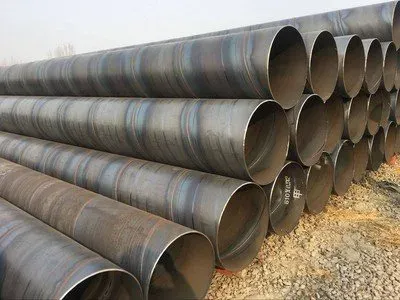
Quick answer: Spiral welded pipe is formed from hot-rolled coil with a helical seam, while straight seam welded pipe is formed from steel plate with a longitudinal seam. Because the helical seam distributes internal pressure differently, spiral pipe can tolerate a thinner wall at the same working pressure and shows better crack resistance, while straight seam pipe remains a long-established choice for line pipe.
What Makes These Two Pipe Types Different
The technical characteristics and production processes of spiral welded pipes and straight seam welded pipes differ, which produces significant differences in their manufacturing routes and in the value they deliver in service.
The comparison below follows three points: the welding process, the strength characteristics under internal pressure, and the metallurgical properties of the material.
Welding Process and Weld Defect Risk
In terms of welding process, spiral welded pipes and straight seam steel pipes use the same welding method. However, straight seam welded pipes inevitably have many T-shaped welds, which greatly increases the probability of welding defects. In addition, the residual stress at the T-shaped weld is relatively high and the weld metal often experiences triaxial stress, which raises the possibility of cracking.
There is a further process point. Under submerged arc welding specifications every weld must have a starting point and an extinguishing point, and in circumferential welding of straight seam welded pipes this requirement is harder to meet, which raises the incidence of arc extinguishing point defects. Careful control of starting and stopping points is therefore a quality priority on both pipe types.
Strength Characteristics Under Internal Pressure
When pipelines are subjected to internal pressure, two principal stresses are usually generated on the pipe wall: radial stress and axial stress. The joint stress at the weld seam is a function of the helix angle of the spiral welded pipe seam.
The helix angle of a spiral welded pipe weld is usually 50 to 75 degrees. At that angle the joint stress at the spiral weld is 60 to 85 percent of the main stress in a straight seam welded pipe. The practical consequence is significant: under the same working pressure, a spiral welded pipe of the same diameter can use a thinner wall than a straight seam welded pipe.
Under the same working pressure, a spiral welded pipe of the same diameter can use a thinner wall than a straight seam welded pipe, because the helical seam spreads the joint stress along a different path.
Metallurgical Properties and the Steel Source
Straight seam submerged arc welded pipes are made from steel plates, while spiral welded pipes are made from hot-rolled coils. The hot-rolled strip rolling process carries a series of advantages that allow high-quality pipeline steel to be produced through the metallurgical route.
For example, the water cooling system on the output gantry can accelerate cooling, allowing low-alloy steel to reach excellent strength grades and low-temperature toughness, which improves the weldability of the steel. Such a system is rare in steel plate rolling mills. In addition, the alloy content, measured as carbon equivalent, of coil steel is usually lower than that of steel plates of the same grade, which also improves the weldability of spiral welded pipes.
Crack Resistance and Service Behavior
The coiling direction of spiral welded pipes is not perpendicular to the pipe axis, because the clamping angle is determined by the helix angle of the pipe. The steel plate rolling direction of straight seam steel pipes, by contrast, is perpendicular to the pipe axis. This difference is the reason the crack resistance of spiral welded pipes is better than that of straight seam steel pipes.
How to Choose Between Them
Choose by the governing requirements of the line. Where wall thickness, weight and crack resistance matter most and the specification allows a helical seam, spiral welded pipe can be the more efficient route. Where the project schedule, available supply or an established specification calls for a longitudinal seam, straight seam welded pipe remains appropriate. Standards such as API, ASTM, GB, DIN, BS, JIS and GOST define the acceptance requirements that apply in each case.
FAQ
Do spiral and straight seam pipes use different welding methods?
No. They use the same welding method. The difference lies in the seam orientation and the resulting weld geometry, defect risk and stress path.
Why can spiral welded pipe use a thinner wall?
Because the helix angle, usually 50 to 75 degrees, reduces the joint stress at the weld to roughly 60 to 85 percent of the main stress in a straight seam pipe at the same pressure.
Which pipe has better crack resistance?
Spiral welded pipe generally shows better crack resistance, because its coiling direction is not perpendicular to the pipe axis, unlike straight seam steel pipe.
Does coil steel have an advantage over plate steel?
Yes. The carbon equivalent of coil steel is usually lower than that of plate of the same grade, and hot-rolled strip lines can accelerate cooling, both of which improve weldability.
Send your standard, sizes and destination port to our engineering team for a confirmed recommendation.