Sep 15, 2026Grades & Materials
Q Series and X Series Welded Steel Pipe Grades: Properties, Production and Applications
Grade reference for Q and X series welded pipe: Q370QE, Q420C, Q420D, Q420QC, Q550QD, Q690D, QSTE550TM, X42, X52M, X52Q, X56Q, X60M, X70 and X90Q.
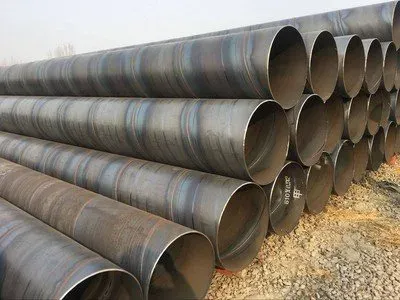
Quick answer: Q series and X series welded steel pipe grades are two naming systems for one broad family of high-strength pipeline and structural pipe. The Q series follows GB/T 1591, where the number is the minimum yield strength in MPa and the trailing letter fixes the impact test temperature. The X series follows API 5L, where the number is the same value in thousands of pounds per square inch. Each grade below has a structured entry covering properties and typical applications.
How Q Series and X Series Designations Work
A Q series designation is a GB/T 1591 code in which Q stands for yield strength, the number is the minimum yield strength in MPa, and the final letter sets the impact test temperature: D is minus 20 degrees C, E as in Q370QE is minus 40 degrees C, and C as in Q420C is 0 degrees C.
An X series designation is an API 5L code in which X stands for pipeline steel and the number is the minimum yield strength in thousands of pounds per square inch, so X60 is about 414 MPa and X90 about 620 MPa. A trailing M records thermo-mechanical controlled processing and Q records quenching and tempering.
X42
X42 is an API 5L high-strength low-alloy line pipe grade stated with yield strength up to 420 MPa, supplied as straight seam welded pipe with a smooth, defect-free surface and a grooved end face. It serves oil and gas, refinery and chemical plant piping, often with a three-layer polyethylene anti-corrosion coating.
X52M
X52M is an API 5L pipeline grade where M records thermo-mechanical rolling, giving good weldability with low-temperature toughness. Stated values are minimum yield strength 360 MPa, tensile strength 460 to 760 MPa and Charpy energy at least 40 J at minus 20 degrees C. It is LSAW made with JCOE or UOE forming and double-sided submerged arc welding, for shale gas and cold-region pipelines.
X52Q
X52Q is a seamless line pipe grade made from high-strength low-alloy steel. The source publishes no numeric yield or tensile values; it attributes strength to material selection, precise rolling, piercing and pickling for a uniform dense structure, heat treatment that removes internal stress, and tensile and hardness testing. Its values should come from the mill certificate.
X56Q
X56Q is an API SPEC 5L PSL2 seamless grade supplied heat treated, with outside diameter 21.3 mm to 1026 mm and wall thickness 2.0 mm to 120 mm. Stated chemistry maxima are carbon 0.18, silicon 0.45, manganese 1.50, phosphorus 0.025, sulfur 0.015, vanadium 0.07, niobium 0.05 and titanium 0.04 percent. Mechanical values are yield strength 390 to 545 MPa, tensile strength 490 to 760 MPa and yield-to-tensile ratio 0.93 or lower.
X60M
X60M is an API 5L pipeline grade where 60 means a minimum yield strength of 60 ksi, about 414 MPa, and M records thermo-mechanical controlled processing. Stated properties are yield strength 414 to 517 MPa, tensile strength 517 to 758 MPa, elongation at least 18 percent and Charpy energy at least 40 J at minus 20 degrees C. Forming covers 406 mm to 1422 mm diameter and 6 mm to 40 mm wall, with hydrostatic testing at 1.5 times design pressure.
X70
X70 is an API 5L PSL2 seamless line pipe grade selected mainly for corrosion resistance. Stated limits are carbon 0.16, manganese 1.70, and phosphorus and sulfur 0.015 percent maximum each, with niobium, vanadium and titanium totalling no more than 0.15 percent. The source reports a hydrogen induced cracking pass rate above 95 percent and a corrosion rate below 0.02 mm per year, using an internal epoxy or polyethylene lining and an external epoxy black paint or three-layer polyethylene coating.
X90Q
X90Q is an API 5L PSL2 grade for high-pressure trunk lines, where Q records quenching and tempering and 90 means a minimum yield strength of 90 ksi, about 620 MPa. Stated values are carbon equivalent 0.43 or less, tensile strength at least 690 MPa, average Charpy energy at least 100 J at minus 20 degrees C and a drop weight tear test shear area at least 85 percent at minus 45 degrees C. It is JCOE formed with four-wire submerged arc welding, under ultrasonic testing and a 22 HRC limit for sour service.
Q370QE
Q370QE is a GB/T 1591 low-alloy high-strength structural steel where Q is yield strength, 370 is the minimum yield strength in MPa and E is the quality grade with good low-temperature impact toughness. Stated values are yield strength at least 370 MPa, tensile strength 490 to 630 MPa and impact toughness retained at minus 40 degrees C. Niobium, vanadium and titanium microalloying with controlled rolling and cooling gives fine ferrite and pearlite of grain size grade 8 or finer. Applications include oil and gas pipelines, cold-region field development and crane booms.
Q420C
Q420C is a normalized low-alloy high-strength structural steel to GB/T 1591-2018 in which C marks impact testing at 0 degrees C. Stated values are carbon 0.20 percent maximum, yield strength at least 420 MPa, tensile strength 520 to 680 MPa, and impact energy at 0 degrees C at least 34 J, about 40 percent stronger than ordinary Q235B pipe. Normalizing is heating 30 to 50 degrees C above Ac3 then air cooling, run at 880 to 930 degrees C under GB/T 8162, GB/T 8163 or API 5L. Applications include shale gas fracturing lines, main steam pipe, wind pipe piles and mining supports.
Q420D
Q420D is a GB/T 1591-2018 low-alloy high-strength structural steel supplied as straight seam welded pipe, where D denotes impact testing at minus 20 degrees C. Stated values are yield strength 420 MPa and tensile strength 520 to 680 MPa, with good plasticity, toughness and cold-region impact performance, and welding may be by submerged arc or high frequency methods. Applications include load-bearing structures in high-rise buildings and sports venues, bridge trusses, heavy machinery frames and wind tower supports.
Q420QC
Q420QC is a low-alloy high-strength structural steel where Q is yield strength, 420 is the minimum yield strength in MPa and QC is the quality grade. The source states a yield strength about 50 percent above ordinary carbon structural steel, tensile strength 520 to 680 MPa and impact toughness retained at minus 40 degrees C. It is made mainly by high frequency resistance welding, or submerged arc welding for large-diameter thick-wall pipe. Use includes oil and gas pipelines, bridge piers and arch ribs, and high-rise structures.
Q550QD
Q550QD is a high-strength low-alloy structural steel made into straight seam welded pipe, where QD records a quality level with good low-temperature impact toughness. Stated values are yield strength at least 550 MPa and tensile strength 630 to 800 MPa with good weldability and formability. Plate is formed and welded, then normalized or tempered to remove stress. Use includes heavy-duty structures in high-rise buildings and large-span sports venues, bridge piers and main beams, and heavy equipment supports.
Q690D
Q690D is a high-strength low-alloy steel where Q is yield strength, 690 is the minimum yield strength in MPa and D is the quality grade for impact testing at minus 20 degrees C. Stated values are yield strength at least 690 MPa, tensile strength 770 to 940 MPa, elongation at least 14 percent and impact energy at least 34 J at minus 20 degrees C, with carbon equivalent normally below 0.47. The source advises low-hydrogen consumables and preheating at 100 to 150 degrees C, with welding under GB/T 1591-2018 or EN 10025-6. Applications include crane booms, mining supports, bridge chords and offshore pipe racks.
QSTE550TM
QSTE550TM is a low-alloy high-strength steel for straight seam welded structural pipe with a minimum yield strength of 550 MPa, where microalloying with controlled rolling and cooling preserves ductility, impact toughness, cold bending and weldability. Stated figures are carbon equivalent 0.44 or less, cold cracking sensitivity coefficient 0.23 or less, and a strength-to-weight ratio that cuts structural weight 10 to 15 percent at equal load. Applications include pump truck and crane booms, commercial vehicle chassis longitudinal beams and wind turbine tower transition sections.
How to Choose Between Q Series and X Series Grades
Choosing between these grades means matching the strength class and the impact test temperature to the project. Both systems carry the strength class in the number: Q370, Q420, Q550 and Q690 parallel X42, X52, X56, X60, X70 and X90, with higher classes suiting lighter structures. C level grades such as Q420C are stated for 0 degrees C, D level grades such as Q420D and Q690D for minus 20 degrees C, and E level Q370QE and QC level Q420QC for minus 40 degrees C.
Process route is the second decision, because it drives weldability and cost. TMCP grades, identified by the M suffix in the X series and by controlled rolling and cooling in the Q370QE and QSTE550TM descriptions, reach strength through a fine-grain structure, which the sources link to stable welding. Quenched and tempered supply, recorded by the Q suffix in X90Q, suits a high strength class that must still deliver toughness, and normalized supply, described for Q420C, suits uniform structure and predictable elongation. Seamless pipe is the stated form for X52Q, X56Q, X70 and Q420C, with the rest supplied as welded pipe.
Selection rule from the source material: pick the strength class first, Q370 through Q690 or X42 through X90, then the suffix that fixes the impact test temperature the site requires, then the process route, TMCP, normalized or quenched and tempered, that fits the welding procedure available on the project.
FAQ
Is Q420D pipe the same as X42 pipe?
No. Q420D is a GB/T 1591-2018 structural grade stated at 420 MPa yield strength with impact testing at minus 20 degrees C, while X42 is an API 5L line pipe grade stated with yield strength up to 420 MPa. The strength level overlaps, but the governing standards and suffix meanings differ, and only the X series carries API 5L PSL designations.
Which grades here are stated for minus 40 degrees C service or lower?
Q370QE and Q420QC are both stated to retain impact toughness at minus 40 degrees C. X90Q is stated with a drop weight tear test shear area of at least 85 percent at minus 45 degrees C, a different test that should not be read as an impact temperature. D suffix grades are stated at minus 20 degrees C and C suffix grades at 0 degrees C.
When should X60M or X90Q be chosen instead of a Q series grade?
The X series grades here are stated specifically for oil and gas pipeline service under API 5L. X60M is stated for high-pressure transmission with hydrostatic testing at 1.5 times design pressure, and X90Q for trunk lines, deepwater laying and hydrogen sulfide service with hardness limited to 22 HRC. A Q series structural grade fits a bridge, machine or pressure component, or where the governing standard is GB/T 1591 or GB/T 8162 and GB/T 8163 rather than API 5L.
What welding method is used for thick-wall high-strength pipe?
The sources separate welding by wall thickness. High frequency resistance welding is stated for thin-wall and small to medium diameter pipe, with about 20 mm to 660 mm quoted for Q690D, while submerged arc welding is stated for thick-wall large-diameter pipe, with about 406 mm to 1420 mm for Q690D and 406 mm to 1422 mm for X60M and X90Q.
Does the source publish mechanical properties for every grade?
No. Numeric values are published for Q370QE, Q420C, Q420D, Q420QC, Q550QD, Q690D, QSTE550TM, X42, X52M, X56Q, X60M, X70 and X90Q, although for Q420D and Q550QD the source gives yield and tensile strength without a numeric impact energy. X52Q is the exception: the source describes the factors behind its strength but publishes no numeric values.
Tell us the strength class, the impact test temperature your site requires, the product form, welded or seamless, and the service environment, and our team will confirm which of these grades fits the project and prepare the matching mill certificate and inspection documents.