Sep 12, 2026Procurement Guides
Internal Anti-Corrosion Treatment for Large Diameter Spiral Steel Pipe
When to apply internal cement mortar lining on large diameter spiral steel pipe, how to prepare the surface, and how to cure it correctly.
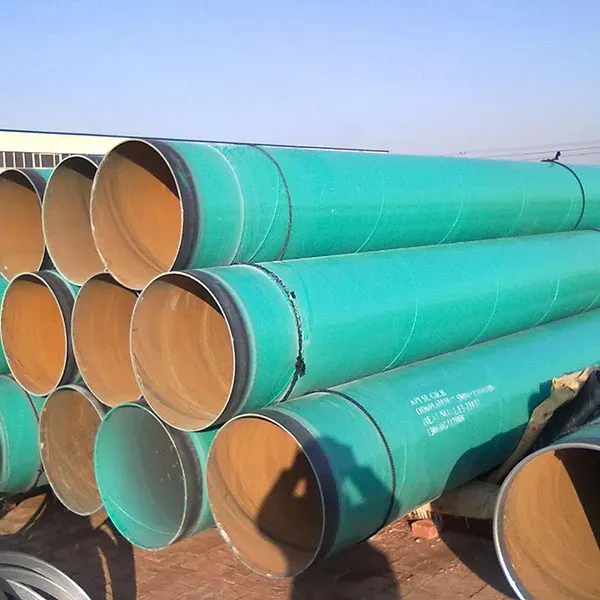
Quick answer: For large diameter spiral steel pipe, internal cement mortar lining should be applied after the pipe is installed, pressure tested, backfilled and compacted to design requirements. The inner wall must be cleaned first, the mortar mix must meet its ratio and strength requirements, and the finished lining must be sealed and wet cured.
Why Timing Matters
Generally speaking, cement mortar coating should be carried out after the installation of spiral steel pipes, after pressure testing, after backfilling and compaction, and once the design requirements are met.
The reason is that spiral steel pipes have low stiffness and thin wall thickness, and the pipeline must be in a stable state during coating. If coating is carried out before laying, significant deformation may occur during lifting, transportation and backfilling, which can damage the anti-corrosion layer.
Preparing the Pipe Surface
Before coating, the inner wall of the spiral steel pipe must be cleaned to remove loose rust, dirt, scale, grease, welding slag and other attachments. A clean surface is what allows the lining to bond.
Two dimensional checks also apply. The protrusion of the inner wall of the spiral steel pipe should not exceed one-third of the design thickness of the anti-corrosion layer. The vertical deformation of the pipeline should not exceed the design specification and should not exceed 2 percent of the inner diameter of the spiral steel pipe.
Cement Mortar Mix Requirements
The internal cement mortar anti-corrosion layer can be built by mechanical spraying, manual plastering, pipe dragging or centrifugal prefabrication. When the layer is prefabricated, protective measures should be taken during transportation, installation and backfilling.
The first construction step is mixing the cement mortar. The mass ratio of cement to sand should be 1 to 1-2, the slump of the cement mortar should be 60 to 80 mm, and the compressive strength should not be less than 30 megapascals.
On large diameter spiral pipe, the anti-corrosion layer should be applied after installation, pressure testing and backfilling - not before laying, when lifting and backfilling can crack it.
Construction Methods
Mechanical spraying can form a smooth, dense and uniformly thick internal anti-corrosion layer of cement mortar, with good results. Mechanical spraying technology began in the 1930s abroad, and in China cities such as Shanghai, Qingdao and Dalian began adopting it in the 1960s.
Other methods, such as the drag tube method or centrifugal prefabrication, have also been widely used. Whichever method is selected, the work should follow the specified mix and thickness so that the layer performs as designed.
Manual Work at Bends, Tees and Valves
When mechanical spraying is used, bends, tees, special steel pipe fittings and pipe sections near gate valves can be manually sprayed and smoothly transitioned into the mechanical spraying layer. These details are where lining continuity is most easily lost, so they deserve specific attention.
Curing: The Step That Decides the Result
Regardless of the construction method, curing is a key step in ensuring that the internal cement mortar anti-corrosion layer does not crack or hollow out. After the cement mortar layer is formed, the steel pipe must be sealed immediately to prevent air convection. After final solidification it should be wetted and cured.
Generally speaking, the curing time for Portland cement should not be less than 7 days, and the curing time for slag Portland cement should not be less than 14 days. Before the pipeline is put into water supply service, it should be kept continuously sealed and moist.
FAQ
When should the internal lining be applied?
After installation, pressure testing, backfilling and compaction, and after design requirements are met, so that the pipeline is stable while the lining is placed.
Why not coat the pipe before laying?
Spiral steel pipe has low stiffness and thin walls. Lifting, transport and backfilling before laying can deform the pipe and damage the anti-corrosion layer.
What mortar mix and strength are required?
The mass ratio of cement to sand should be 1 to 1-2, slump should be 60 to 80 mm, and compressive strength should not be less than 30 megapascals.
How long should the lining be cured?
Portland cement should be cured for not less than 7 days and slag Portland cement for not less than 14 days, with the pipe kept sealed and moist.
Send your standard, sizes and destination port to our engineering team for a confirmed recommendation.