Sep 12, 2026Procurement Guides
What Material Are Boiler Tubes Made From?
Boiler tubes are usually seamless, ranging from carbon steel SA210 C to alloy grades such as T11, T22 and T91 and stainless TP347H.
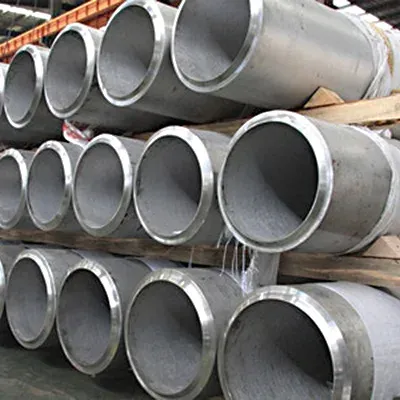
Quick answer: Boiler tubes are usually made from seamless steel pipe, not welded pipe. Carbon steel such as ASME SA210 C covers lower-temperature sections, while alloy grades such as SA213 T11, T12, T22, T23, T91 and T92 and stainless grades such as TP347H and SUPER304H take the hotter parts of the boiler.
Why Boiler Tubes Are Seamless
Boiler steel pipe includes medium-pressure and high-pressure boiler tube. It is usually manufactured by the seamless process, because welded pipe is not considered suitable for this service. The absence of a seam supports the pressure and temperature capability the boiler tube must provide.
Water Tube and Fire Tube Boilers
In a water tube boiler, water flows inside tubes that are heated from the outside by hot gas. Fuel burns in the furnace and the heat raises steam in the tubes. In smaller boilers the furnace is separated from the external heating tubes, while in larger boilers the tubes form the furnace wall and generate steam. In a fire tube boiler, hot gas flows through one or more tubes that are surrounded by water. Heat passes through the tube wall by conduction and heats the water. This arrangement is used in the horizontal locomotive configuration of almost all steam locomotives: the pressure vessel holds the fire, with an extension at one end for the firebox, and the assembly forms a rectangular or conical structure outside the cylindrical shell.
Carbon Steel Boiler Tube
For a large unit, the lower-temperature material is carbon steel. ASME SA210 C is the common grade. It is widely used in 300 MW, 600 MW and other large-capacity power station boilers at working temperatures below 500 C, for example in the water wall, economizer and low-temperature superheater.
Alloy Steel Boiler Tube
Alloy grades cover the hotter sections. ASME SA213 T11 is used for boiler, superheater and heat exchanger tube. ASME SA213 T12 is widely used in boiler superheater, reheater and other heating surface piping, headers and main steam pipelines at working temperature up to about 550 C in large-capacity units. ASME SA213 T22 is used mainly for superheaters with a wall temperature up to about 580 C and steam pipe and headers up to about 540 C, and it is a mature grade with a long operating history in the United States, Japan and Europe. ASME SA213 T23 suits superheater, reheater and water wall duty in large utility boilers and is a good choice for main steam below about 620 C. ASME SA213 T91 is used for high-temperature superheaters, reheaters and other pressure parts of subcritical and supercritical boilers with wall temperature up to about 625 C, and also for pressure vessels and nuclear high-temperature parts. ASME SA213 T92 performs at temperatures up to about 650 C and can partly replace TP304H and TP347H austenitic tubes in subcritical, supercritical and even ultra-supercritical boilers.
The GB 5310 grades are also widely used. 15CrMoG applies to high and medium pressure boiler steam pipes, headers and superheater tubes with a wall temperature around 540 C, and to forgings and elastic elements at steam parameters of 510 C. 12Cr1MoVG is mainly used for boiler superheater and reheater piping and other heating surface systems with a metal wall temperature up to about 580 C, and for headers and main steam pipe pressure parts up to about 565 C.
Stainless Steel Boiler Tube
Stainless grades serve the highest-temperature and most corrosive positions. SA213 TP347H can be used in high-temperature, high-pressure environments, with a maximum operating temperature of about 650 C for pressure parts and about 850 C for oxidation-resistant parts, mainly for high-temperature superheaters and reheaters on large subcritical and supercritical boilers. SA213 TP347HFG is used for high-temperature superheater, reheater and platen superheater sections in supercritical boilers. SUPER304H (S30432) is used for superheaters and reheaters of ultra-supercritical boilers with metal wall temperature up to about 700 C. HR3C (SA213 TP310HCbN) has good high-temperature corrosion resistance, including steam oxidation resistance, and its allowable stress is much improved over ordinary SA213 TP310H, so it is used in superheaters of ultra-supercritical boilers with harsh working conditions.
Boiler tube material follows wall temperature: carbon steel for the coolest sections, chrome-moly alloys for the middle range, and stainless or high-alloy grades where temperature and steam oxidation rise.
How SPAI STEEL Supports Boiler Tube Projects
SPAI STEEL, founded in 1996 and part of the SP Group, supplies seamless pipe and tube for power and process use, including equivalent grades to those listed above. Alloy and stainless products are made at the Longwan, Wenzhou base, with carbon steel production in Jinghai, Tianjin. Pipe can be produced to GB, API, ASTM, ASME/ANSI, BS, DIN, JIS and GOST standards and inspected by SGS, BV, TUV or TUBOSCOPE, with cutting, threading, coating, custom fabrication, packing and marking services.
FAQ
Are boiler tubes seamless or welded?
Boiler tubes are usually made by the seamless process. Welded pipe is generally not used for this service.
What is the most common carbon steel boiler tube grade?
ASME SA210 C is a common carbon steel grade for large power station boilers at working temperatures below about 500 C.
Which material is used for the hottest boiler sections?
Stainless and high-alloy grades such as SUPER304H and HR3C are used for the hottest superheater positions in ultra-supercritical boilers.
How do I choose between T22 and T91?
Match the grade to the metal wall temperature and pressure. T22 is a mature choice for moderate high-temperature duty, while T91 is used where higher temperature and creep strength are required.
Send SPAI STEEL your boiler tube grade, size, wall thickness and operating conditions, and our team will confirm a suitable seamless tube and arrange inspection, marking and documentation for your order.