Sep 13, 2026Standards & Testing
ASTM A335 P91 Alloy Steel Pipe: Performance, Application and Production
ASTM A335 P91 is a 9% Cr-1% Mo martensitic heat-resistant alloy pipe for high-temperature service: key properties, sizes and production.
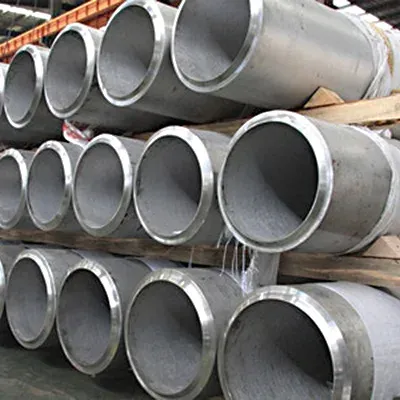
Quick answer: ASTM A335 P91 is a 9% Cr-1% Mo martensitic heat-resistant alloy steel pipe built for high-temperature, high-pressure service. It delivers a tensile strength of at least 585 MPa, a yield strength of at least 415 MPa and strong creep resistance, which is why it is a standard choice for power plant steam lines and petrochemical process piping. Common sizes run from 57 mm to 762 mm outside diameter with wall thickness from 5.0 mm to 130 mm.
What Makes ASTM A335 P91 Pipe Different
The defining feature of P91 is its chemistry: roughly 9% chromium with about 1% molybdenum. The chromium-rich composition supports a stable protective surface layer at elevated temperature, while molybdenum contributes solid-solution strengthening. The result is a martensitic heat-resistant steel that holds its strength and stability where plain carbon steel and many low-alloy grades have already softened. Two properties matter most to buyers: high-temperature strength and creep resistance. Creep is the slow, permanent deformation that develops when a material is held under load at high temperature for a long period. P91 is selected specifically because it resists that deformation, so it can keep performing under long-term, high-pressure, high-temperature duty.
Chemical Composition and Mechanical Properties
Chemical composition
For ASTM A335 P91 seamless pipe, the usual chemical composition is: carbon 0.08 to 0.12%, manganese 0.30 to 0.60%, phosphorus 0.020% maximum, sulfur 0.010% maximum, silicon 0.20 to 0.50%, chromium 8.0 to 9.5%, molybdenum 0.85 to 1.05%, vanadium 0.18 to 0.25%, nitrogen 0.030 to 0.070%, nickel 0.40% maximum, aluminium 0.040% maximum and niobium 0.06 to 0.10%. Vanadium and niobium are present at controlled, relatively low levels, and nitrogen is specified within a narrow band, because together they influence the high-temperature properties of the finished pipe.
Mechanical properties
The specified mechanical properties are a tensile strength of at least 585 MPa and a yield strength of at least 415 MPa. Because these values are obtained through controlled chemistry and thermal treatment rather than by alloying alone, the delivery condition is heat treated. That means the pipe is supplied in the condition in which the specified properties are met, and it should not be treated as an as-rolled product.
Standard Dimensions and Delivery Condition
P91 pipe is commonly produced by hot rolling or forging. The usual size window is 57 mm to 762 mm outside diameter with wall thickness from 5.0 mm to 130 mm. Pipes are required to comply with the type test rules for pressure pipeline components, and the delivery condition is heat treated so that the specified mechanical properties and microstructure are achieved. Wall thickness selection is normally driven by the design pressure and temperature, so the size should always be calculated rather than assumed.
Where ASTM A335 P91 Pipe Is Used
In the petrochemical industry, P91 pipe is widely used to manufacture pipelines, containers and reactors. Those services combine high temperature, high pressure and corrosive conditions, and the performance requirements are demanding. P91 meets them through a combination of high-temperature strength and corrosion resistance, which helps equipment operate safely and steadily over a long campaign.
In the power industry, P91 is commonly used for high-temperature, high-pressure steam pipelines and heat exchangers, which are key components of power plants. The pipe withstands the impact of high-temperature, high-pressure steam, supporting stable plant operation and generation efficiency. Outside these two core sectors, it is also used in aerospace applications for high-temperature engine components and in automotive exhaust and cooling systems, where heat resistance and reliability are the priorities.
P91 is chosen less for its room-temperature strength than for its ability to hold strength and resist creep during long-term high-temperature, high-pressure service - that is the property that decides most P91 projects.
How ASTM A335 P91 Pipe Is Produced
Production follows a sequence of raw material selection, smelting, forming, heat treatment and quality inspection. High-quality raw material is the foundation: alloying elements are supplied at high purity, finely proportioned and carefully processed. During smelting, the temperature and chemical composition are tightly controlled to keep the molten steel pure and uniform.
The forming stage uses controlled molds and cooling to achieve dimensional accuracy and a uniform internal structure. Heat treatment is then applied to relieve internal stress and improve mechanical properties and corrosion resistance. Finally, the pipe passes strict quality inspection and surface treatment so that both appearance and internal performance meet the standard requirements.
How to Specify and Order P91 Pipe
When requesting a quotation, state the standard, outside diameter, wall thickness, length, quantity, delivery condition and any inspection or test requirements you need. Include the intended service temperature and pressure if they are known, because these drive the wall thickness calculation. If you need fittings or flanges for the same line, mention them together so that material and pressure ratings stay consistent.
FAQ
Is ASTM A335 P91 pipe seamless or welded?
P91 for high-temperature service is commonly supplied as seamless pipe, produced by hot rolling or forging. Seamless construction removes a longitudinal weld from the pressure boundary, which is why it is the usual choice for critical high-temperature lines.
What delivery condition does P91 pipe come in?
It is supplied heat treated. The heat treatment develops the specified mechanical properties and produces the microstructure the grade is designed around, so the pipe arrives ready for fabrication rather than needing property development at the buyer end.
What size range is available in P91?
The typical range is 57 mm to 762 mm outside diameter with 5.0 mm to 130 mm wall thickness. Sizes outside that window may be feasible, but the working wall thickness should always follow the design pressure and temperature.
Which industries use P91 alloy pipe?
The main users are power generation for steam lines and heat exchangers, and petrochemical plants for pipelines, containers and reactors. Aerospace and automotive high-temperature components are also typical applications.
Send your standard, sizes and quantity to our engineering team for a confirmed recommendation.